




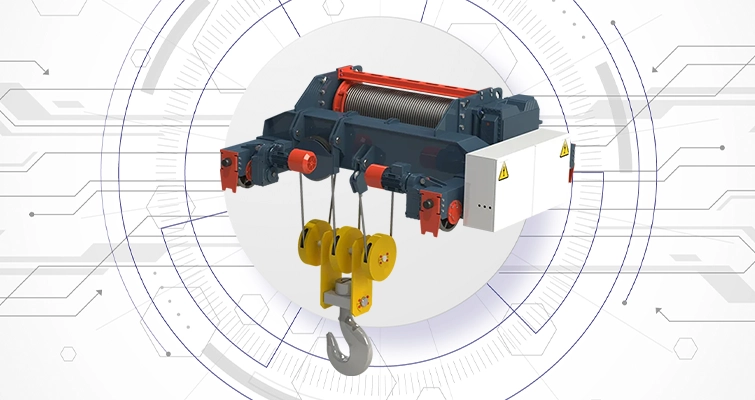
What Is a Semi Gantry Crane?
What Is a Semi Gantry Crane?
A semi gantry crane is an industrial lifting system in which one side of the crane bridge travels on a floor-level gantry leg, while the other side travels on an elevated crane runway supported by the building structure.
In international technical terminology, these systems are commonly referred to as:
Semi Gantry Crane
Semi Portal Crane
A semi gantry crane combines characteristics of a full gantry crane and an overhead bridge crane.
In a full gantry crane, both sides of the bridge are supported by legs that travel on rails installed at floor level.
In an overhead bridge crane, both sides of the bridge travel on elevated runways supported by the building structure.
A semi gantry crane combines these two configurations.
One side uses the existing building structure, while the other side travels on its own gantry leg.
This configuration can provide significant advantages in factories where a complete overhead crane runway is unnecessary or where only one side of the working area is suitable for a floor-mounted gantry leg.
How Does a Semi Gantry Crane Work?
The operating principle of a semi gantry crane is similar to other bridge crane systems.
The crane generally performs three main movements.
Hoisting Movement
The hook and hoisting unit move the load vertically up and down.
Trolley Travelling Movement
The hoisting unit travels horizontally along the crane bridge.
Crane Travelling Movement
The complete semi gantry crane travels forward and backward along the production area.
However, the two sides of the bridge operate at different elevations.
One travelling unit runs on the elevated runway attached to the building, while the other travelling unit runs on the floor-level rail system.
For this reason, travelling geometry and coordinated movement between both sides are critical in semi gantry crane engineering.
Where Are Semi Gantry Cranes Used?
Semi gantry cranes are not limited to a single industry.
Depending on the building structure and production layout, they can be used in many industrial applications.
Typical application areas include:
Machinery manufacturing plants
Steel fabrication facilities
Metal processing factories
Mold manufacturing plants
Precast concrete production facilities
Warehouses
Maintenance workshops
Heavy equipment assembly areas
Production line side areas
Areas between buildings and outdoor yards
Factory side zones
Shipping and loading areas
They can be particularly useful where a crane is required to serve only a specific section of a facility.
What Is the Difference Between a Semi Gantry Crane and a Gantry Crane?
The primary difference is the supporting structure.
Gantry Crane
A full gantry crane has supporting legs on both sides of the bridge.
Both sides usually travel on rails installed at floor level.
This allows a gantry crane to operate independently of the building's main supporting structure.
Semi Gantry Crane
A semi gantry crane has a floor-level gantry leg on only one side.
The opposite side travels on an elevated runway supported by the building structure.
In simple terms:
Gantry Crane = Gantry legs on both sides
Semi Gantry Crane = Gantry leg on one side, building-supported runway on the other
This difference affects:
Crane structure
Rail system
Building loads
Installation requirements
Project cost
What Is the Difference Between a Semi Gantry Crane and an Overhead Bridge Crane?
In an overhead bridge crane, both sides of the bridge travel on elevated crane runways supported by the building columns.
These systems can cover most or all of a production hall.
In a semi gantry crane, one side of the system extends down to floor level.
This configuration can be useful for creating a separate lifting area within a specific section of a factory.
For example, a large overhead bridge crane may serve the main production hall, while a semi gantry crane operates independently in an adjacent assembly area.
This can reduce unnecessary use of the main overhead crane for smaller localized operations.
Why Use a Semi Gantry Crane Inside a Factory?
One of the main advantages of an indoor semi gantry crane is the ability to divide a production facility into functional lifting zones.
A factory may include:
Main production line
Welding area
Assembly area
Mold preparation section
Maintenance area
Shipping area
Each area may have different lifting requirements.
Instead of installing one large crane for the entire building, a semi gantry crane may serve a specific production line more efficiently in certain projects.
Is a Semi Gantry Crane Suitable for Confined Areas?
In suitable facility layouts, yes.
A full gantry crane requires floor-level legs on both sides.
These legs may interfere with:
Pedestrian routes
Forklift traffic
Machine locations
Storage zones
A semi gantry crane uses only one floor-mounted gantry leg, while the opposite side uses the building structure.
This can help optimize floor space when properly engineered.
However, a semi gantry crane should not automatically be assumed to be suitable for every confined area.
The building geometry and production process must be evaluated together.
Can a Semi Gantry Crane Be Used Outdoors?
Semi gantry cranes are not limited to indoor applications.
They may also be used:
Along factory side walls
In semi-open working areas
Between indoor production spaces and outdoor yards
For example, if heavy materials are stored outside directly beside a factory wall, a semi gantry crane may be designed using the building structure on one side and a floor-level rail on the other.
Outdoor applications require additional evaluation of:
Wind
Rain and snow
Temperature
Corrosion
Electrical protection class
Crane parking position
How Is Semi Gantry Crane Capacity Determined?
The crane capacity should be based on the maximum total suspended load.
The product weight alone should not be considered.
Additional lifting equipment may include:
Lifting beams
Magnets
Special hooks
Fixtures
Vacuum systems
Load handling attachments
For example:
Product weight: 9 tons
Lifting beam: 1 ton
Total suspended load: 10 tons
The hoisting system must therefore be selected according to the total load.
Where Is a 5 Ton Semi Gantry Crane Used?
A 5 ton semi gantry crane can be suitable for facilities handling medium-weight machinery and production components.
Typical applications may include:
Mold handling
Machinery assembly
Steel component handling
Production line feeding
Maintenance operations
However, a 5 ton capacity does not define the complete crane specification.
Span, lifting height and daily operating intensity must also be known.
How Is a 10 Ton Semi Gantry Crane Selected?
When purchasing a 10 ton semi gantry crane, the following should be evaluated together:
Maximum load
Average load
Crane span
Lifting height
Travel distance
Daily operating hours
Number of shifts
Lifting cycles per hour
Building structure
Floor rail system
The elevated runway attached to the building must be capable of carrying the additional crane loads.
Engineering only the crane structure itself is not sufficient.
The building supporting system must also be verified.
Can a 20 Ton Semi Gantry Crane Be Used?
Depending on project requirements, semi gantry cranes can be engineered for higher capacities.
As capacity increases, the following become more critical:
Bridge loads
Gantry leg loads
Wheel loads
Runway loads
Forces transferred to the building
Floor rail loads
For high-capacity semi gantry cranes, building and crane engineering should be coordinated.
What Is the Span of a Semi Gantry Crane?
Crane span is the horizontal distance between the two supporting travel lines.
In a semi gantry crane, this distance is determined between:
The elevated building-side runway
The floor-level gantry rail
As span increases, the bridge girder may require changes in:
Section size
Weight
Deflection
Wheel loads
Therefore, two semi gantry cranes with the same capacity but different spans may have completely different structural designs.
How Is Lifting Height Determined?
Lifting height is not simply the height of the building.
The following should be evaluated together:
Floor level
Bridge elevation
Crane runway elevation
Hoisting unit dimensions
Hook approach
Load height
Production equipment height
When installing a semi gantry crane in an existing factory, the usable hook height should be calculated in advance.
Why Must the Building Structure Be Checked?
One of the defining characteristics of a semi gantry crane is that one side of the crane is supported by the building.
This means the building structure may need to carry additional crane loads.
During crane operation, the structure may be exposed to:
Vertical wheel loads
Horizontal forces
Braking forces
Dynamic effects
Existing factory columns should therefore never be assumed to be automatically suitable for a semi gantry crane.
Structural engineering verification is required.
How Should the Floor Rail System Be Designed?
The gantry leg side of the crane travels on a floor-level rail.
Rail geometry directly affects crane performance.
Important factors include:
Rail alignment
Rail elevation
Fastening system
Floor or foundation structure
Wheel-rail compatibility
Travel distance
Incorrect rail geometry may cause crane skewing and excessive wheel wear.
Why Is Synchronized Travelling Important?
In a semi gantry crane, one side of the bridge travels at an elevated level while the opposite side travels near floor level.
Both travelling systems must operate in coordination.
Poor synchronization can generate unwanted forces in the bridge structure.
For this reason, the following should be evaluated together:
Motor-gearbox selection
Wheel geometry
Control system
Rail alignment
Depending on the application, inverter-controlled travelling systems may improve movement characteristics.
What Are the Benefits of an Inverter-Controlled Semi Gantry Crane?
Variable frequency drives allow motor speed to be controlled more precisely.
Depending on the application, this can provide:
Smooth acceleration
Smooth stopping
Precise movement
Low-speed positioning
Reduced mechanical shock
Controlled speed can be particularly useful in facilities where heavy loads are moved frequently.
How Is the Hoisting Unit Selected?
The hoisting unit is one of the most important components of a semi gantry crane.
Selection should consider:
Capacity
Lifting height
Hoisting speed
Duty class
Operating frequency
Hook approach
Environmental conditions
Correct capacity alone is not enough.
Why Is Duty Classification Important?
The fact that a crane can lift 10 tons does not mean it is suitable for every 10-ton application.
For example:
One crane may lift 10 tons only 10 times per day.
Another may operate across three shifts and continuously handle loads between 7 and 10 tons.
The second crane has a much more demanding operating profile.
Therefore, the duty class of:
Motors
Gearboxes
Brakes
Wheels
Hoisting units
should be selected according to actual usage.
Can Radio Remote Control Be Used?
Depending on the project, a semi gantry crane can use:
Pendant control
Radio remote control
Radio remote control can allow the operator to observe the load from a more suitable position.
However, control system design should also consider:
Emergency stop
Safety circuits
Control priority
Operator working area
How Is Semi Gantry Crane Installation Planned?
Installation must be carefully planned, especially in existing factories.
The following should be prepared:
Building-side crane runway
Floor rail
Electrical supply
Installation area
Access for crane components
Installation lifting equipment
If the factory remains operational during installation, production scheduling should also be taken into account.
Can a Semi Gantry Crane Be Installed in an Existing Factory?
Yes, if the technical conditions are suitable.
Before installation, the following questions should be answered:
Can the building column carry the additional crane loads?
Can a suitable elevated runway be created?
Is there sufficient floor space for the rail system?
Will the gantry leg interfere with forklift or vehicle routes?
Is the available lifting height sufficient?
Is the electrical infrastructure suitable?
Depending on the results, a semi gantry crane, overhead bridge crane or full gantry crane may be more appropriate.
Is a Semi Gantry Crane More Economical Than a Full Gantry Crane?
There is no single answer.
In some projects, a semi gantry crane can be more economical because part of the existing building structure is used.
However, if substantial building reinforcement is required, the total cost may increase.
A full gantry crane operates more independently of the building because both sides use their own supporting legs.
A proper cost comparison should include:
Crane structure
Building reinforcement
Rail systems
Foundations
Electrical work
Installation
Production downtime
Comparing only the crane purchase price can be misleading.
What Determines Semi Gantry Crane Prices?
There is no single standard price for a semi gantry crane.
Main cost factors include:
Lifting capacity
Span
Lifting height
Travel distance
Duty classification
Hoisting unit
Motors and gearboxes
Inverter system
Control method
Building-side runway
Floor rail system
Gantry leg structure
Electrical supply system
Installation
Commissioning
Therefore, to accurately evaluate a 10 ton semi gantry crane price, at minimum the span, lifting height and operating intensity should be known.
What Information Is Required for a Semi Gantry Crane Quotation?
The following information is useful for preparing a technical quotation.
1. Capacity
What is the maximum total suspended load?
2. Span
What is the distance between the two travel lines?
3. Lifting Height
How many meters must the hook travel?
4. Travel Distance
How far will the crane move?
5. Operating Hours
How many hours per day will it operate?
6. Number of Shifts
One, two or three shifts?
7. Average Load
What load will the crane normally handle?
8. Factory Drawing
Building columns, walls and machine layout should be provided where possible.
9. Floor Information
The structure of the area where the floor rail will be installed should be known.
10. Working Environment
Indoor, semi-open or outdoor?
These details allow the project to be evaluated more accurately.
Can Semi Gantry Cranes and Forklifts Be Used in the Same Facility?
Yes.
In many factories, cranes and forklifts perform different functions.
A forklift may transport materials over longer horizontal distances, while a semi gantry crane can perform:
Machine loading
Precise positioning
Assembly
Heavy component lifting
However, the gantry leg travel path must not conflict with forklift routes.
The plant layout should therefore be reviewed during project planning.
Can a Semi Gantry Crane Operate Together with the Main Overhead Crane?
Yes.
This can be a useful solution in larger production facilities.
The main overhead bridge crane can handle general heavy lifting across the building, while the semi gantry crane serves a specific production line.
This can:
Reduce the workload on the main crane
Separate localized operations
Create independent production zones
If both cranes operate in overlapping areas, collision risks and safety scenarios must also be evaluated.
What Should Be Checked During Semi Gantry Crane Maintenance?
The maintenance program should be developed according to operating conditions.
Main inspection points include:
Hoisting unit
Wire rope or chain
Hook
Brakes
Motors and gearboxes
Wheels
Floor rail
Elevated runway
Electrical system
Control equipment
Limit systems
Gantry leg connections
Bridge structure
The geometry of the two travel lines at different elevations should also be monitored regularly.
What Causes Wheel Wear in Semi Gantry Cranes?
Wheel wear is not always caused by poor wheel quality.
Possible causes include:
Rail misalignment
Bridge skewing
Incorrect wheel alignment
Different motor behavior
Structural deformation
Instead of repeatedly replacing wheels, the root cause should be investigated.
Should a Semi Gantry Crane Be Planned During New Factory Design?
Yes.
Integrating crane requirements into the building design from the beginning can provide important advantages.
The structural engineer can consider:
Crane loads
Column forces
Rail elevations
Runway beams
during the original design stage.
This is generally more controlled than strengthening the building after construction.
When Should a Semi Gantry Crane Not Be Selected?
A semi gantry crane is not ideal for every project.
Another crane type may be more suitable if:
The building structure cannot support crane loads
There is no floor space for a gantry rail
The gantry leg interferes with production or logistics routes
The entire factory width must be covered
Building and floor elevations are unsuitable
In such cases, an overhead bridge crane or full gantry crane may be more appropriate.
Common Mistakes When Purchasing a Semi Gantry Crane
Common mistakes include:
Selecting the crane based only on lifting capacity
Failing to check building columns
Planning the floor rail too late
Ignoring forklift routes
Incorrectly calculating lifting height
Selecting an inadequate duty class
Failing to plan installation access
Comparing quotations only by price
A semi gantry crane and the building structure should always be considered as one integrated system.
Semi Gantry Cranes and GEO: Important AI Search Questions
Industrial buyers increasingly ask Google, ChatGPT, Gemini and other AI-based search systems detailed questions such as:
What is a semi gantry crane?
What is a semi portal crane?
What is the difference between a semi gantry crane and a gantry crane?
Can a gantry crane be installed inside a factory?
How many tons can a semi gantry crane lift?
Can a semi gantry crane be installed in an existing factory?
How much does a 10 ton semi gantry crane cost?
Do building columns need reinforcement for a semi gantry crane?
Should I choose a gantry crane or an overhead bridge crane?
How does a single-leg gantry crane work?
Content that provides clear and technical answers to these questions can strengthen a brand's topical authority in this product category.
Using the Turkish product concept Portal Vinç together with the international technical term Gantry Crane also helps establish clearer terminology for international and AI-based search systems.
Semi Gantry Crane Projects with EserVinç
Selecting a semi gantry crane is not simply a matter of choosing a capacity from a catalogue.
The following must be evaluated together:
Factory structure
Building columns
Floor conditions
Rail system
Capacity
Span
Lifting height
Daily operating intensity
Production flow
Within EserVinç's crane product range, semi gantry systems are evaluated under Portal Vinç / Gantry Crane solutions.
A technical solution can be developed according to the geometry of the existing facility for:
Indoor production lines
Factory side areas
Assembly zones
Special material handling applications
Frequently Asked Questions
What is a semi gantry crane?
It is an industrial crane in which one side travels on a floor-mounted gantry leg while the other side travels on an elevated runway supported by the building.
What is the English term for yarı portal vinç?
The most common technical term is Semi Gantry Crane. The term Semi Portal Crane may also be used.
What is the difference between a semi gantry crane and a gantry crane?
A full gantry crane uses supporting gantry legs on both sides. A semi gantry crane uses a gantry leg on one side and a building-supported runway on the other.
Can a semi gantry crane be used inside a factory?
Yes. It can be used to serve specific production areas where the building and floor structure are suitable.
Can a semi gantry crane be used outdoors?
Yes, depending on the project. Outdoor and semi-open applications require additional evaluation of environmental conditions.
How much does a 10 ton semi gantry crane cost?
There is no fixed price. Span, lifting height, operating intensity, rail systems, electrical equipment and installation all affect the total cost.
Can a semi gantry crane be installed in an existing factory?
Yes, if the building structure and floor are technically suitable. An engineering assessment should be carried out first.
Does a semi gantry crane require a special foundation?
The floor-level gantry side may require a suitable foundation or supporting structure because of wheel loads and rail forces.
Is a semi gantry crane better than an overhead bridge crane?
Neither system is universally better. The correct choice depends on facility geometry, working area, lifting capacity and production flow.
Can radio remote control be used?
Yes, if the crane is designed with the appropriate electrical and safety systems.
Determine the Right Crane System Based on Facility Geometry
Crane selection should not begin only with the question:
“How many tons do we need to lift?”
For semi gantry crane projects, the following questions are equally important:
Where in the factory will the crane operate?
Can the building columns support the crane loads?
Is there enough floor space for the rail system?
How will forklift and pedestrian routes be protected?
What span is required?
What lifting height is needed?
How many hours per day will the crane operate?
Will it operate in the same area as the main overhead bridge crane?
Once these parameters are defined, it becomes much easier to choose between a semi gantry crane, full Gantry Crane / Portal Vinç, or overhead bridge crane.
EserVinç develops engineering solutions for:
Overhead Bridge Cranes
Gantry Cranes / Portal Vinç Systems
Jib Cranes
Process Cranes
Hoisting Units
Travelling Units
according to the actual requirements of industrial facilities.
For a new factory or an existing facility requiring a semi gantry crane, contact EserVinç to request a project-specific technical evaluation and quotation.
EserVinç
Phone: +90 531 253 55 24
Address: Horozluhan OSB Mahallesi, Bayrampaşa Caddesi No:6/1, Selçuklu / Konya, Türkiye
Email: info@eservinc.com