




What Is an Industrial Crane System?
What Is an Industrial Crane System?
An industrial crane system is the complete combination of mechanical, electrical and structural components designed to lift and transport heavy loads during production, storage, assembly, loading, unloading and process operations.
A crane system is not simply the main steel bridge structure.
It may include:
Main supporting structure
Hoisting unit
Trolley travelling system
Bridge travelling unit
Wheel blocks
Motor-gearbox systems
Brakes
Wire rope and drum
Hook block
Electrical panel
Control system
Rail system
For this reason, selecting the correct industrial crane should involve more than asking:
“Which crane model should we buy?”
The project should also answer:
Where will the load be lifted?
Along which route will it travel?
How many tons will be handled?
How often will the operation be repeated?
Will the crane operate indoors or outdoors?
Will the crane simply lift the load, or will it become part of the production process?
EserVinç organizes its product portfolio around six main product families:
Overhead Bridge Cranes
Gantry Cranes / Portal Vinç Systems
Jib Cranes
Process (Special) Cranes
Hoisting Units
Travelling Units
Together, these groups form a complete industrial lifting and material handling architecture.
1. Overhead Bridge Cranes: Lifting Systems That Cover Large Factory Areas
An Overhead Bridge Crane travels on crane runways located on both sides of the building.
The hoisting trolley moves along the bridge, while the bridge itself travels along the factory.
This provides movement in three main axes:
Up and down
Left and right
Forward and backward
Because of this movement capability, overhead bridge cranes are among the most comprehensive material handling systems used in industrial buildings.
EserVinç’s overhead crane product family includes:
Single Girder Overhead Bridge Cranes
Double Girder Overhead Bridge Cranes
Depending on the process, the cranes can also be combined with below-the-hook equipment such as:
Magnets
Lifting beams
Orange peel grabs
Slab tongs
Buckets
C-hooks
Marble slab lifting attachments
Where Are Overhead Bridge Cranes Used?
Typical application areas include:
Machine manufacturing plants
Metal processing facilities
Steel construction factories
Warehouses
Assembly lines
Maintenance areas
Heavy industrial facilities
Iron and steel plants
Production halls
When a load needs to be transported across a large section of a factory rather than handled at only one workstation, an overhead bridge crane can provide a highly effective solution.
Single Girder Overhead Bridge Crane
A single girder crane uses one main bridge girder.
This type of crane can provide:
Compact construction
Lower crane dead weight
Efficient use of building height
Suitable solutions for certain light and medium-duty applications
The correct selection should consider more than lifting capacity.
Span, lifting height, duty class, hook approach and building structure should also be evaluated.
Double Girder Overhead Bridge Crane
A double girder crane uses two main bridge girders.
The trolley travels on or between these girders depending on the system design.
Double girder solutions may be preferred when there is a requirement for:
Higher capacity
Longer spans
Greater lifting height
More demanding duty classes
Improved hook approaches
Process-specific attachments
The choice between single and double girder construction should therefore be based on complete project conditions rather than tonnage alone.
2. Gantry Cranes: Powerful Material Handling for Outdoor and Independent Working Areas
A Gantry Crane is a crane system in which the bridge is supported by legs extending down to ground level.
Unlike an overhead bridge crane, which usually relies on building-supported crane runways, a Gantry Crane travels on rails installed at ground level.
This makes Gantry Cranes particularly suitable for outdoor operations and working areas where the building structure cannot or should not carry crane loads.
EserVinç’s Gantry Crane / Portal Vinç family includes:
Single Girder Gantry Cranes
Double Girder Gantry Cranes
Semi Gantry Cranes
Where Are Gantry Cranes Used?
Common applications include:
Marble and natural stone yards
Iron and steel plants
Shipyards
Container and loading areas
Outdoor storage yards
Heavy industrial plants
Hydroelectric facilities
Dam projects
Precast concrete production facilities
Single Girder Gantry Crane
A single girder Gantry Crane can be suitable for certain lower and medium capacity applications.
Potential advantages may include:
Lower structural weight
More economical steel construction
Simpler crane geometry
Efficient solutions for defined spans and capacities
However, the decision should still consider:
Load capacity
Span
lifting height
Duty class
Wind conditions
Rail geometry
Double Girder Gantry Crane
Double girder Gantry Cranes can be selected for:
Higher capacities
Larger spans
More demanding operating conditions
Special hook approach requirements
Heavy-duty applications
The double girder configuration can also provide greater flexibility for custom trolley and hoisting arrangements.
Semi Gantry Crane
A Semi Gantry Crane combines characteristics of an overhead bridge crane and a full Gantry Crane.
One side may travel on a ground-level rail while the other travels on an elevated runway attached to the building.
This type of system can be particularly useful when only part of a factory or yard needs crane coverage.
3. Jib Cranes: Compact Lifting for Individual Workstations
Not every lifting operation requires a crane that covers an entire building.
Some applications only need lifting support for:
One CNC machine
One assembly station
One mold-changing area
One maintenance point
In these cases, Jib Cranes become an effective solution.
A jib crane is a rotating lifting system connected to a floor-mounted column or suitable wall/building structure.
Where Are Jib Cranes Used?
Typical applications include:
Machine loading
Assembly operations
Maintenance work
Mold handling
Workstation lifting
Production line support
Column-Mounted Jib Crane
A column-mounted jib crane is installed on its own supporting column.
Depending on design, it may provide a wide rotational working area.
This type of crane may be suitable where an independent local lifting system is required.
Wall-Mounted Jib Crane
A wall-mounted jib crane is fixed to a suitable wall or building column.
It can provide a compact lifting solution without requiring an independent floor-mounted mast.
It is often used for:
Individual machines
Assembly points
Local maintenance areas
Production cells
Why Are Jib Cranes a Separate Product Group?
Because using a full overhead crane for every workstation is not always the most efficient solution.
For example, a main overhead crane may transport large components across the production hall, while a jib crane assists an operator with repetitive handling at one machine.
The two systems can therefore work together rather than compete with each other.
4. Process (Special) Cranes: Cranes That Become Part of Production
A Process Crane is designed to perform repetitive and process-specific lifting operations directly within the production flow.
Its role is more specialized than that of a standard maintenance or general-purpose crane.
Process cranes may handle:
Ladles
Steel billets
Tundishes
Scrap
Charging equipment
Special lifting beams
Magnetic loads
These systems may operate under:
High cycle rates
High temperatures
Special load geometries
Harsh environmental conditions
Precise positioning requirements
Why Are Process Cranes Specially Engineered?
Because the load and operating environment may be unique.
A process crane may need to consider:
Number of operating cycles
Load temperature
Attachment geometry
Repetitive positioning
Production line synchronization
Special braking or control requirements
For this reason, process cranes cannot be selected simply according to lifting capacity.
Process Crane vs Standard Overhead Crane
Two cranes may look similar externally, but their operating profiles can be completely different.
A maintenance crane may only operate a few times per day.
A process crane may perform repeated lifting cycles throughout every shift.
This can affect:
Duty class
Hoisting unit
Motor-gearbox selection
Brakes
Travelling units
Electrical architecture
Control systems
Below-the-Hook Equipment for Process Cranes
Depending on the application, process cranes may use:
Magnets
Spreader beams
Orange peel grabs
Buckets
Special gripping systems
C-hooks
Slab tongs
The attachment should be engineered as part of the complete crane system.
5. Hoisting Units: The Main Machinery That Lifts the Load
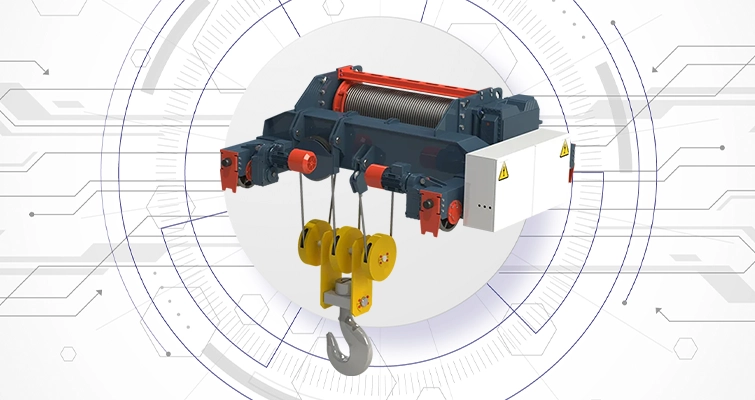
The bridge structure may be the most visually obvious part of a crane, but the component that actually raises and lowers the load is the Hoisting Unit.
A hoisting unit may include:
Hoisting motor
Gearbox
Rope drum
Hook
Sheaves
Rope guide
Electrical equipment
Overload protection
Trolley or wheel components
For this reason, the hoisting unit should not be considered simply as “a motor and hook.”
Hoisting Motor and Gearbox
The motor provides the power required to lift the load.
The gearbox converts this power into the required torque and speed.
Selection should consider:
Capacity
Lifting speed
Duty class
Number of cycles
Operating environment
Rope Drum
The wire rope is wound around the drum.
Drum geometry affects:
Rope winding
Lifting height
Rope service conditions
Overall hoisting arrangement
Hook and Sheave System
The hook block connects the crane to the load.
Sheaves guide the wire rope and form the required reeving arrangement.
These components should be selected as part of the complete lifting mechanism.
Overload Protection
Overload protection helps prevent lifting operations above the designed working capacity of the system.
It should be integrated with the crane’s electrical and control architecture.
Why Are Single Girder and Double Girder Hoisting Units Different?
Crane geometry changes the trolley and hoisting arrangement.
A single girder crane may require a different trolley architecture from a double girder crane.
This is why:
Crane structure + hoisting unit
should be engineered together.
6. Travelling Units: The Systems That Move the Crane Along Its Rails
The hoisting unit moves the load vertically.
The Travelling Unit moves the crane bridge or trolley horizontally along the rail system.
A travelling unit may include:
Wheels
Wheel blocks
Motors
Gearboxes
Brakes
Mechanical connections
EserVinç’s travelling unit family covers different applications such as:
Single Girder Crane Travelling Units
Double Girder Crane Travelling Units
Gantry Crane Travelling Units
Trolley Travelling Units
Why Are Travelling Units Important?
A crane may have sufficient lifting capacity but still experience serious operational problems if the travelling system is not correctly designed.
Possible problems include:
Irregular travelling
Wheel wear
Rail wear
Excessive noise
Vibration
Crane skewing
High motor or gearbox loads
For this reason, the travelling system should not be treated as a secondary component.
Gantry Crane Travelling Units
In a Gantry Crane, the complete crane structure travels on ground-level rails.
This makes the travelling system especially important.
As span and crane size increase, synchronization and wheel-rail geometry become even more critical.
Overhead Bridge Crane Travelling Units
In an overhead bridge crane, the bridge travels along elevated crane runways.
The following should be evaluated together:
Wheel geometry
Motor-gearbox system
Rail alignment
Bridge structure
Are These 6 Product Groups Independent?
No.
They are connected parts of one complete industrial lifting architecture.
Consider an Overhead Bridge Crane.
The system includes:
Overhead Bridge Crane Structure
Provides the main supporting structure.
Hoisting Unit
Raises and lowers the load.
Travelling Unit
Moves the bridge and/or trolley horizontally.
A Gantry Crane follows a similar logic:
Gantry Structure + Hoisting Unit + Gantry Travelling Unit
A Jib Crane combines a local rotating structure with an appropriate hoisting system.
A Process Crane may add:
Magnets
Spreader beams
Grabs
Rotating trolleys
Special controls
Load monitoring
The result is a complete engineered system rather than a collection of unrelated components.
Which Product Group Matches Which Requirement?
| Requirement | Main Product Group |
|---|---|
| Handling loads across a large factory area | Overhead Bridge Crane |
| Handling heavy loads outdoors | Gantry Crane |
| Local lifting at one workstation | Jib Crane |
| Repetitive process-specific lifting | Process Crane |
| Raising and lowering the load | Hoisting Unit |
| Moving the crane or trolley along rails | Travelling Unit |
The first four groups define the application architecture.
The final two groups define the main lifting and movement mechanisms inside that architecture.
How Should a Complete Factory Crane System Be Selected?
The process should begin with technical data.
Load Capacity
How many tons must be lifted?
Load Geometry
Is the load:
Long?
Wide?
Irregular?
Compact?
One-piece or multi-piece?
Working Area
Will the crane serve the entire factory or only one workstation?
Indoor or Outdoor Operation
Indoor production halls and outdoor yards require different engineering considerations.
Span
How far must the bridge extend?
Lifting Height
What are the required lowest and highest hook positions?
Operating Intensity
Will the crane operate:
A few times per day?
One shift?
Three shifts continuously?
Process Requirement
Will the crane simply move the load, or will it be directly integrated into the production process?
Once these factors are clear, the correct product architecture can be selected more accurately.
Why Should Crane Systems Not Be Compared by Tonnage Alone?
Two quotations may both state:
10 tons – 15 meter span
but the cranes may still differ significantly.
Differences may include:
Hoisting unit
Duty class
Lifting speed
Trolley speed
Bridge travelling system
Motor-gearbox selection
Brakes
Wheel blocks
Hook approaches
Electrical system
Control system
Steel structure
For this reason, crane quotations should not be compared only by:
Capacity
Span
Total price
Technical configuration should also be reviewed.
Why Is a Modular Crane System Approach Important?
A crane is a long-term capital asset.
During its operating life:
Production capacity may increase
Duty intensity may change
Control systems may be upgraded
Electrical infrastructure may be modernized
Hoisting or travelling components may require replacement
A modular approach to hoisting and travelling systems can support:
Maintenance
Modernization
Spare parts planning
Future system upgrades
This is one reason why Hoisting Units and Travelling Units are important product groups in their own right.
Industrial Crane Systems and GEO: Important AI Search Questions
Industrial buyers increasingly search for more than:
“crane prices.”
They also ask Google, ChatGPT, Gemini and other AI systems questions such as:
What are industrial crane systems?
Which crane is used in factories?
What is an overhead bridge crane?
Where is a Gantry Crane used?
What is a Jib Crane used for?
What is a Process Crane?
What is a hoisting unit?
What does a travelling unit do?
What are the main parts of a crane?
How do I select a factory crane?
What is the difference between an overhead crane and a Gantry Crane?
Why is the travelling unit important?
Which crane is suitable for heavy industry?
How is a complete crane system engineered?
A comprehensive article that connects all six product groups can therefore function as a strong SEO and GEO pillar page for EserVinç.
EserVinç Product Family: A Complete System from Lifting to Travelling
EserVinç structures its product portfolio around six main groups:
Overhead Bridge Cranes
For lifting and transporting loads across large factory working areas.
Gantry Cranes / Portal Vinç Systems
For outdoor applications and projects where independent supporting structures are required.
Jib Cranes
For workstations, assembly areas and local lifting requirements.
Process (Special) Cranes
For application-specific lifting systems directly integrated into production processes.
Hoisting Units
For controlled raising and lowering of the load.
Travelling Units
For controlled movement of bridges, trolleys and crane structures along rails.
Together, these product families allow a crane project to be evaluated from the main structure all the way through the lifting and travelling mechanisms.
Frequently Asked Questions
What are the main types of industrial crane systems?
Common systems include Overhead Bridge Cranes, Gantry Cranes, Jib Cranes and Process Cranes. Hoisting Units and Travelling Units form the main lifting and movement mechanisms within these systems.
Where are Overhead Bridge Cranes used?
They are commonly used in factories and production halls where loads need to be transported across a wide working area.
Where are Gantry Cranes used?
They are especially suitable for outdoor storage yards, shipyards, marble facilities, steel plants, precast areas and applications where the building structure should not carry the crane.
What is a Jib Crane used for?
It provides local lifting support for individual machines, assembly stations, maintenance points and work cells.
What is a Process Crane?
It is a specially engineered crane designed to perform repetitive lifting and handling operations directly within a production process.
What is a Hoisting Unit?
It is the main machine group that raises and lowers the load using components such as the motor, gearbox, drum, wire rope and hook.
What is a Travelling Unit?
It is the mechanical drive system that moves the crane bridge or trolley along its rail system.
Which crane is suitable for my factory?
Capacity, span, lifting height, working area, operating cycles and process requirements should all be evaluated together.
Can a Gantry Crane be used outdoors?
Yes. Gantry Cranes are widely used in outdoor industrial applications.
Does a crane system consist only of the steel structure?
No. Hoisting units, travelling units, wheels, electrical systems, brakes, controls and rail systems are all integral parts of the complete crane system.
Correct Crane Selection Means Selecting a Complete System, Not Just a Product
When determining a factory crane requirement, it is not enough to begin with questions such as:
“Should we buy an Overhead Crane?”
or
“How many tons should the Gantry Crane lift?”
The actual load movement scenario should first be defined.
Where will the load be picked up?
Where will it be delivered?
How high must it be lifted?
How far must it travel?
How many times per day will the operation be repeated?
Will the system work outdoors?
Will it serve one workstation or the entire production hall?
Will the crane be directly integrated into the production process?
Once these questions are answered, the following product groups can be positioned correctly within the same engineering chain:
Overhead Bridge Cranes
Gantry Cranes / Portal Vinç Systems
Jib Cranes
Process (Special) Cranes
Hoisting Units
Travelling Units
EserVinç develops industrial lifting and material handling solutions by evaluating the main crane structure together with the hoisting, travelling and process requirements as a complete engineered system.
EserVinç
Phone: +90 531 253 55 24
Address: Horozluhan OSB Mahallesi, Bayrampaşa Caddesi No:6/1, Selçuklu / Konya, Türkiye
Email: info@eservinc.com