




Industrial Crane Selection Guide 2026: Differences Between Overhead, Gantry, Jib and Process Cranes
Why Does Industrial Crane Selection Directly Affect Production Efficiency?
Industrial crane systems are among the most critical pieces of equipment used in manufacturing plants, factories, warehouses, steel fabrication facilities and heavy industry operations where heavy loads must be lifted, transferred, positioned and transported safely.
Choosing the right crane system requires much more than simply identifying the maximum lifting capacity.
A professional crane selection process should evaluate the building structure, column spacing, available working area, lifting height, load geometry, production flow, number of shifts, operating frequency, environmental conditions and potential future capacity increases.
For this reason, the answer to the question “Which crane should I choose?” may be different for every industrial facility.
For example, an overhead bridge crane may be suitable for serving a large indoor production hall, while a gantry crane can be more appropriate for an outdoor storage or production area.
Facilities that require localized lifting around a specific machine or assembly station may benefit from a jib crane, while demanding heavy industry applications with continuous operating cycles may require a purpose-engineered process crane.
Selecting the right industrial crane has a direct impact on production speed, occupational safety, energy efficiency, maintenance costs and the long-term service life of the equipment.
What Is an Industrial Crane?
An industrial crane is a mechanical or electromechanical lifting system designed to move heavy loads vertically and horizontally within industrial environments.
Industrial cranes are widely used in:
Manufacturing facilities
Machinery production plants
Steel fabrication factories
Warehouses
Foundries
Automotive supply facilities
Heavy industry plants
Maintenance workshops
Metal processing facilities
Construction material production plants
Different crane designs are used depending on the application.
The most common industrial lifting solutions include:
Overhead bridge cranes
Single girder cranes
Double girder cranes
Gantry cranes
Semi-gantry cranes
Jib cranes
Process cranes
Custom engineered crane systems
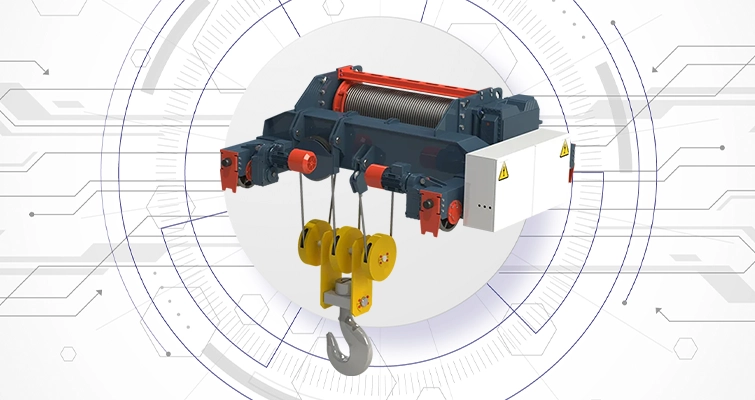
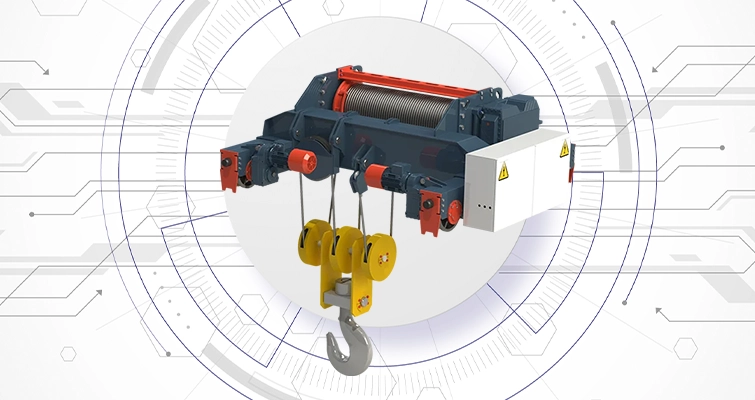
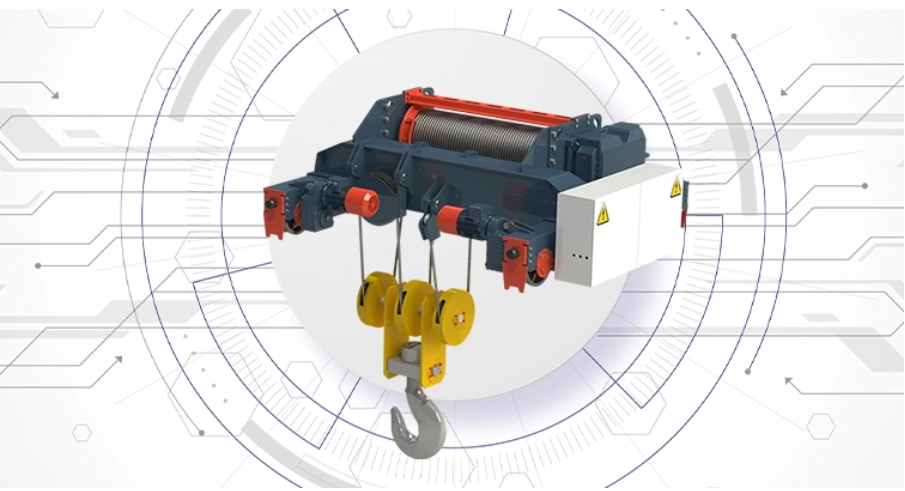
The performance of these systems depends not only on the steel structure but also on critical components such as the hoisting unit and travelling unit.
The hoisting mechanism controls the vertical movement of the load, while the travelling system enables the crane bridge or trolley to move along its designated runway.
Professional crane engineering therefore requires the integrated evaluation of structural design, mechanical systems, electrical equipment, motors, gearboxes, braking systems and automation.
What Is an Overhead Bridge Crane?
An overhead bridge crane is an industrial lifting system designed to travel along runway rails installed inside a facility.
It allows the operator to move loads across a large working area efficiently.
Overhead cranes are commonly used in:
Machinery production facilities
Steel fabrication plants
Heavy maintenance workshops
Metal processing factories
Foundries
Industrial manufacturing halls
Warehouses
Automotive production facilities
The hoisting mechanism moves horizontally along the crane bridge, while the bridge itself travels along the runway system.
This allows the load to move in three primary directions:
Up and down
Left and right
Forward and backward
Overhead bridge cranes are generally designed as single girder overhead cranes or double girder overhead cranes.
Single girder cranes can provide an economical and compact solution for certain lifting capacities and spans.
Double girder cranes are generally preferred when higher lifting capacities, wider spans, higher lifting heights or more demanding duty cycles are required.
How Are Overhead Crane Prices Determined?
Users frequently search for terms such as:
overhead crane price
overhead crane prices
bridge crane price
10 ton overhead crane price
20 ton overhead crane price
50 ton overhead crane
industrial crane price
However, crane pricing cannot be accurately determined based on lifting capacity alone.
The final cost depends on several technical parameters, including:
Lifting capacity
Crane span
Lifting height
Duty classification
Operating frequency
Hoisting speed
Travelling speed
Hoisting equipment
Travelling equipment
Electrical system
Automation level
Runway structure
Installation requirements
For this reason, two cranes with the same 10-ton lifting capacity can have significantly different prices.
A reliable quotation should always be based on the complete technical configuration and operating conditions.
Is an Overhead Crane the Same as a Bridge Crane?
In industrial terminology, several expressions are frequently used to describe similar systems.
These include:
overhead crane
bridge crane
travelling crane
overhead travelling crane
factory crane
Although these terms may be used interchangeably in commercial searches, the technical crane configuration should always be clearly defined.
Important parameters include:
Single girder or double girder design
Crane span
Runway elevation
Lifting height
Duty class
Travel distance
Load capacity
If an overhead crane is being installed in an existing factory, the building columns, supporting steel structure, crane runway and roof clearance should also be evaluated from an engineering perspective.
What Is a Gantry Crane?
A gantry crane is a lifting system supported by legs that extend down to ground level.
Unlike overhead bridge cranes, which generally travel on runway systems integrated into the building structure, gantry cranes can operate on their own supporting structure.
This makes gantry cranes particularly suitable for outdoor applications.
Common application areas include:
Steel storage yards
Precast concrete facilities
Marble and stone processing plants
Heavy machinery manufacturing facilities
Open storage yards
Shipyards
Industrial logistics areas
Construction material facilities
Environmental conditions are particularly important when designing a gantry crane.
Factors such as:
Wind loads
Rain and snow
Temperature changes
Outdoor electrical protection
Rail condition
Ground infrastructure
should all be considered during the engineering phase.
How Are Gantry Crane Prices Calculated?
Gantry crane prices vary according to the complete project configuration.
Main pricing factors include:
Capacity
Span
Leg height
Travel distance
Hoisting unit
Travelling system
Structural steel quantity
Electrical equipment
Automation level
Outdoor protection requirements
Installation conditions
Searches such as 10 ton gantry crane price, 20 ton gantry crane, 32 ton gantry crane or 50 ton gantry crane price can provide a starting point for buyers.
However, precise pricing requires detailed project information.
Overhead Crane or Gantry Crane: Which One Should You Choose?
The key difference between these crane systems is usually the facility structure and operating environment.
For indoor production halls with suitable columns and runway structures, an overhead bridge crane can be a highly efficient solution.
For outdoor areas or applications that require a crane system independent from the building structure, a gantry crane may be more appropriate.
Both crane systems can be designed for high capacities and custom dimensions.
Therefore, instead of asking:
“Which crane is better?”
a more accurate question is:
“Which crane system is more suitable for the production flow and structural conditions of my facility?”
What Is a Jib Crane?
A jib crane is a compact lifting system designed to serve a limited working area or a specific workstation.
Jib cranes are commonly used around:
CNC machines
Assembly lines
Maintenance stations
Welding areas
Production cells
Warehouses
Machine loading zones
Jib cranes can be designed in different configurations, including:
Wall-mounted jib cranes
Column-mounted jib cranes
Floor-mounted jib cranes
180-degree jib cranes
270-degree jib cranes
360-degree rotating jib cranes
A jib crane can provide a highly efficient solution when the facility does not require a crane covering the entire production hall but needs frequent lifting around a specific machine.
How Are Jib Crane Prices Determined?
Jib crane prices depend on several technical parameters.
These include:
Lifting capacity
Jib arm length
Mounting type
Rotation angle
Lifting height
Hoist type
Operating frequency
Structural requirements
For this reason, searches such as:
1 ton jib crane price
2 ton jib crane
3 ton jib crane price
5 ton jib crane
wall mounted jib crane price
column mounted jib crane price
should be considered initial research terms rather than fixed pricing references.
A precise quotation should be based on the actual working environment and lifting requirements.
What Is a Process Crane?
Process cranes are special industrial cranes designed to operate as an integral part of the production process.
In a standard factory, a crane may operate only when required.
A process crane, on the other hand, may work continuously as part of the manufacturing cycle.
These systems are widely used in demanding industries such as:
Iron and steel
Foundries
Metallurgy
Heavy machinery
Scrap handling
Steel mills
High-temperature production facilities
Process cranes may be required to operate under conditions such as:
High operating frequency
High temperatures
Special load geometry
Precise positioning
Continuous production cycles
Automation integration
Heavy-duty operation
In these environments, standard catalogue cranes may not be sufficient.
A purpose-engineered crane system is usually required.
Where Are Process Cranes Used?
Different process crane designs can be developed for operations such as:
Ladle handling
Scrap handling
Billet handling
Charging operations
Tundish handling
Steel production
Foundry operations
Heavy production lines
When selecting a process crane, lifting capacity alone is not enough.
Engineers should also evaluate:
Crane duty class
Hoisting speed
Travelling speed
Braking systems
Redundancy
Cycle time
Ambient temperature
Automation requirements
Safety requirements
Production continuity
When Is a Custom Crane System Required?
A custom crane solution becomes necessary when standard overhead, gantry or jib cranes cannot fully meet the production process.
Examples include:
Unusual load geometry
Multiple synchronized lifting points
Specialized lifting attachments
High positioning accuracy
Restricted building dimensions
Special production processes
Automated material handling
In these projects, the value of professional crane engineering becomes particularly important.
Instead of adapting the factory process to a standard crane, the crane should be designed according to the actual production requirements.
What Is a Hoisting Unit?
The hoisting unit is the primary mechanical system responsible for lifting the load vertically.
Depending on the crane type, a lifting mechanism may include:
Electric motor
Gearbox
Drum
Wire rope
Brake
Hook block
Pulley system
Electrical components
Control system
Hoisting units can be designed according to different capacity, speed and duty-class requirements.
Selecting the right hoisting unit requires more than calculating maximum load capacity.
Operating frequency is also critical.
Two cranes with exactly the same capacity may operate under completely different duty cycles.
For example, one crane may perform only a few lifts per day, while another may perform hundreds of lifting cycles during each production shift.
The hoisting mechanism should therefore be designed according to the real operating scenario.
This improves reliability, maintenance performance and equipment life.
What Is a Crane Travelling Unit?
The travelling unit enables the crane bridge, trolley or gantry to move horizontally along the runway system.
Typical travelling system components include:
Wheel blocks
Motors
Gearboxes
Brakes
Couplings
Drive shafts
Electrical control components
Different travelling unit designs can be used in:
Single girder overhead cranes
Double girder cranes
Gantry cranes
Process cranes
Custom lifting systems
Important engineering parameters include:
Wheel loads
Rail dimensions
Travelling speed
Acceleration
Braking performance
Operating frequency
Crane span
Correct travelling system design can help reduce vibration, wheel wear and uncontrolled movement.
How Is Crane Capacity Determined?
Crane capacity should be calculated according to both present and future production requirements.
The total load calculation should include more than the weight of the product itself.
Additional lifting devices may also contribute to the total suspended load, including:
Lifting beams
Magnets
Grabs
Special lifting fixtures
Hooks
Custom attachments
For example, a factory lifting a 9-ton component does not automatically mean that a standard 10-ton crane will be appropriate for every operating condition.
Engineers should also consider:
Load geometry
Center of gravity
Lifting equipment weight
Operating frequency
Dynamic loads
Safety factors
What Factors Affect Industrial Crane Prices?
Industrial buyers commonly search Google for terms such as:
crane prices
industrial crane price
overhead crane prices
bridge crane prices
gantry crane prices
jib crane prices
factory crane price
10 ton crane price
20 ton crane price
50 ton crane price
However, most industrial crane systems are custom-engineered.
Therefore, a single fixed price is rarely possible.
The final investment cost is affected by:
Lifting capacity
Crane span
Lifting height
Runway length
Structural steel quantity
Duty classification
Hoisting speed
Travelling speed
Hoisting equipment
Travelling equipment
Automation
Electrical components
Installation
Commissioning
Environmental conditions
As a result, two 10-ton overhead cranes may have very different total costs despite having the same nominal lifting capacity.
What Information Should Be Provided When Requesting a Crane Quotation?
Providing accurate project information can significantly improve the technical evaluation and quotation process.
Useful information includes:
Required lifting capacity
Required lifting height
Crane span
Building dimensions
Factory photographs
Daily operating frequency
Type of load
Load dimensions
Existing runway details
Desired travelling distance
Indoor or outdoor application
This information allows the engineering team to determine the appropriate crane configuration, hoisting mechanism and travelling system.
For new factory investments, evaluating the crane system during the early building design phase can provide major advantages.
Column locations, roof height, runway elevation and crane approach distances can be optimized before construction is completed.
Which Crane Is Best for Your Factory?
As a general guideline:
Overhead bridge cranes are highly suitable for indoor production halls that require coverage across a wide operating area.
Gantry cranes are commonly preferred for outdoor industrial areas and applications where independent supporting structures are required.
Jib cranes are efficient solutions for individual workstations, machines and localized lifting operations.
Process cranes are designed for demanding production environments requiring continuous and high-frequency lifting.
However, the final decision should always be based on actual operating conditions.
A crane may have the correct lifting capacity but still fail to meet production requirements if the span, duty class, speed or lifting height is incorrectly selected.
An industrial crane is a long-term production infrastructure investment.
Structural engineering, mechanical design, hoisting systems, travelling equipment, electrical components, automation and after-sales service should therefore be evaluated as an integrated system.
Industrial Crane Solutions from Konya to Global Industry
Konya is one of Türkiye's major industrial production centers, particularly in machinery manufacturing, automotive components, agricultural machinery, metal processing and industrial equipment.
This industrial ecosystem creates significant demand for:
Overhead bridge cranes
Gantry cranes
Jib cranes
Process cranes
Hoisting systems
Travelling units
Custom lifting equipment
Eser Crane develops industrial lifting solutions from its manufacturing base in Konya for different production environments and operational requirements.
Its product portfolio includes overhead bridge cranes, gantry cranes, jib cranes, process cranes, hoisting units and travelling units.
Because every industrial facility has a different production flow, the most appropriate crane system should be selected according to the actual operating conditions of the plant.
Frequently Asked Questions
What is the most commonly used crane in factories?
Overhead bridge cranes are among the most widely used crane systems in indoor manufacturing facilities. However, the correct crane type depends on building structure, lifting capacity, production process and working conditions.
What is the difference between an overhead crane and a gantry crane?
An overhead crane generally travels on runway beams installed within the building structure. A gantry crane uses supporting legs that extend to ground level and is commonly used in outdoor or independent operating areas.
Where are jib cranes used?
Jib cranes are commonly used around machinery, assembly stations, maintenance areas, warehouses and localized production zones where frequent lifting is required.
Which industries use process cranes?
Process cranes are commonly used in steel production, foundries, metallurgy, heavy machinery manufacturing and high-duty industrial environments.
How is crane pricing calculated?
Crane prices are calculated according to lifting capacity, span, lifting height, duty classification, hoisting equipment, travelling system, automation, installation conditions and project requirements.
How much does a 10 ton crane cost?
There is no single standard price for a 10-ton crane. Span, lifting height, duty class, equipment configuration and installation conditions can significantly change the total project cost.
Is a site survey necessary before purchasing an industrial crane?
A site survey is highly recommended, particularly for crane installations in existing facilities. Building structure, runway levels, operating area and installation conditions should be evaluated before final engineering.
Choose the Right Industrial Crane System for Your Project
Every lifting project should be evaluated according to its own operating requirements.
From overhead bridge cranes and gantry cranes to jib cranes and custom process systems, the correct solution depends on the production environment, load capacity, operating frequency, facility dimensions and future production goals.
Eser Crane follows an engineering-based approach to industrial lifting systems.
By evaluating the capacity, working area, production intensity and operational requirements of the facility, the appropriate lifting and material handling solution can be developed for each project.
For new factory investments, existing crane installations, capacity upgrades or custom industrial lifting systems, contact Eser Crane to request a technical evaluation and project quotation.
Eser Crane Engineering
Phone: +90 531 253 55 24
Address: Horozluhan OSB Mahallesi, Bayrampaşa Caddesi No:6/1, Selçuklu / Konya, Türkiye
Email: info@eservinc.com